

Rules, Principles, Whimsy
An accumulation of thoughts that power a film.
Happy 2026. As part of the next chapter of Little Scraps of Filmmaking, I’m going to be sharing more of my process, and more from the new film I’m currently in production on.
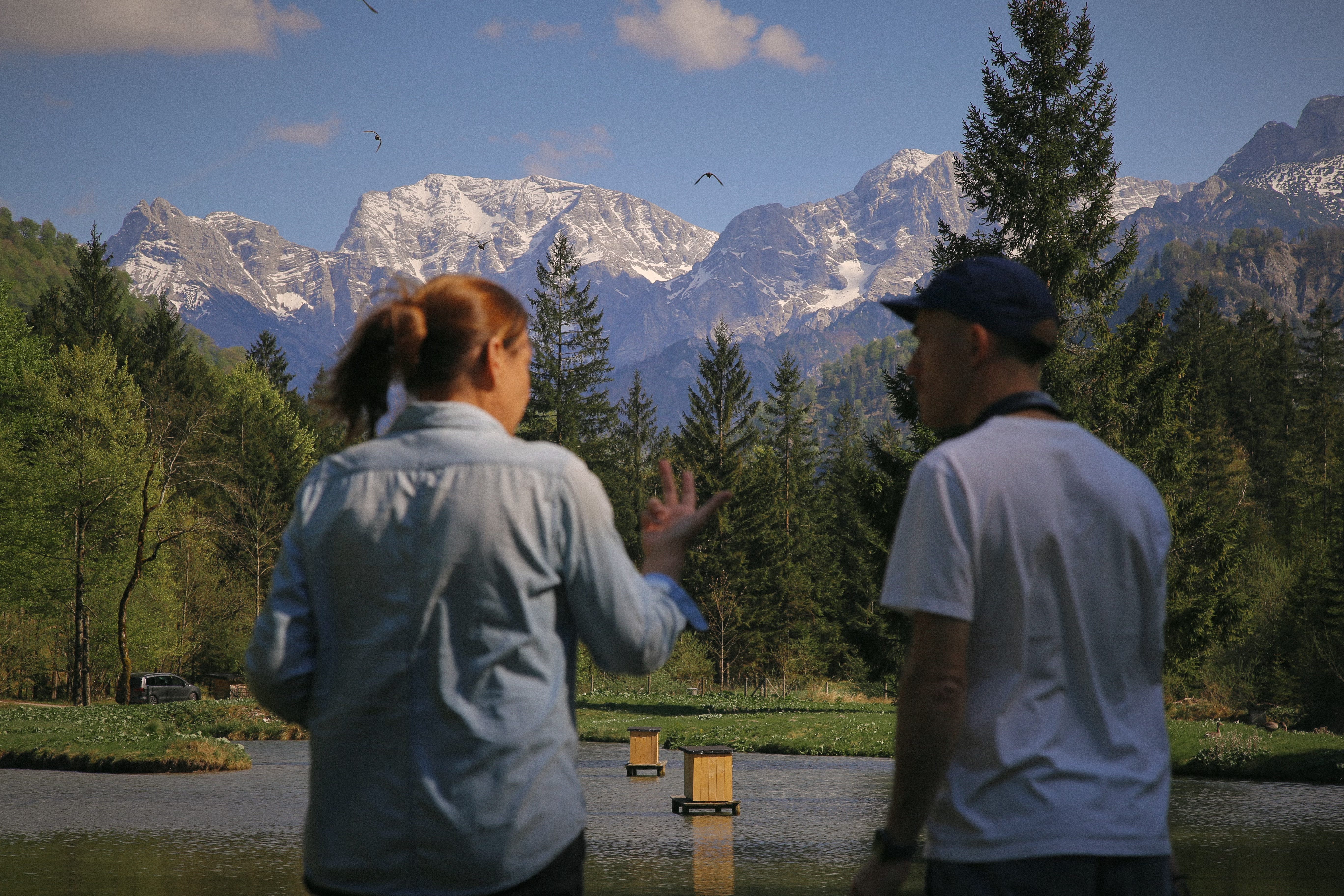
When I start developing an idea, I always have too many ideas. A bundle of thoughts and scenes and questions that I want to explore.
Then I lose myself in research and get a million more.
Writing (and the real work) becomes about distilling and combining and simplifying and connecting. And that process leaves lots of the ideas that I found fascinating out of the film. You can’t even see a trace of them.
Many of them are sparks that have inspired me, or led me somewhere meaningful, but just sit in my ever growing pile of notebooks knowing they helped me along the way.
As I’ve talked about here, I’m making a new feature length documentary. It’s about people studying bird language, and how a life of questioning and trying to understand something other than ourselves can lead to empathy and wonder.
Along the way, I’ve accumulated lots of thoughts - already too many to fit into 30 feature films. So I thought I’d share some and see what they inspire.
All of it is about the idea that much of the world is hidden from us, that we don’t perceive it and don’t understand it, and that it is worth understanding and it is necessary to understand. - Ed Yong
What a banger to start with. Ed Yong is a phenomenal science writer, sounds like a lovely human being and in this quote from an interview he gave to the NY Times he’s talking about his fascination with the natural world and his work. But for me, that’s a very very good description of my work, my life and the process of making films.
Which leads me to this one from Gary Kowalski:
Art arises from a spiritual longing that all people share: to make our mark on the world and to spend our life energy in a work that rises above the mundane, adding grace to existence. We respond to the light of the world around us by giving expression to our own inner light, and when the two are on the same wavelength, the world seems more brilliant and finely focused.
A constant parallel I’ve seen whilst speaking to the people in the film is between art and science. The dedication of lives to trying to make sense of the unknown, however difficult or unknowable.
One of the things I enjoy and can’t stop myself doing when I’m researching, is swinging wildly between all kinds of different sources. The historical, the personal, the academic, the cinematic, the ephemeral, the literary.
Which means I get to take tangents to read any great writer who has touched on anything close to the subject I’m working on.
And as with most things, Ursula Le Guin has written something beautiful and entertaining and accessible and deep about the language of animals:
Sometimes I copy down multiple paragraphs from what I’m reading or listening to. Other times it’s single sentences or words. I try not to have too much order to it. The connections come later.
Like this:
The Eromecene - the Age of Loneliness. Edward O. Wilson
And that little sentence or idea will spin off, cannoning through my brain as I wonder about what I’m making and what the hell it means.
Other times I’ll be reading a book on my subject and find a quote that has nothing to do with what I’m writing, but I save it anyway because I want to use it in an argument in the future so that I sound really clever (or because the writer has written something way better than I would be able to put it).
Dogs and house cats are, biologically speaking, subsidized predators, wreaking havoc in local ecosystems. From Animal Talk by Eugene S Morton & Jake Page
Between all of these kind of ideas, I often find something that absolutely nails a central tenet of what I want to do. It’s less a piece of information or an idea for the film, more a guiding principle that I add to my rules on the film.
I return to the word “whimsicality” which I used to describe one of the characteristics of Nature. Without some recognition of that element, we do not correctly weigh our visible world. Harry Beston.
I don’t want to make a serious film. Or rather, I don’t want to make a film that is only serious. It needs to be joyous, and entertaining and full of wonder SO THAT it can lead people to a deeper place. Too often films about heavy subjects forget that.
That idea has worked its way into not only this film, but my process in general. All of my work and my way of working should have a sense of whimsicality to it. Not a twee Etsy sort of whimsicality, but a genuine sense of wonder and spontaneity; of unexpected beauty and pure delight.
If I can work in that way, day by day, then I think things will be ok.
After this kind of deep, underpinned idea lands, then for a while my brain feels ripe and open and full of possibility. I know what the film is about. I have my guiding principles.
And then I’ll find something that I think is just fucking great, gives me hope and strength for what I’m trying to make and it powers me forward.
Like this from the writer Jenny Odell:
Okay, there’s two reasons I don’t offer simple answers. One of them is what I already said earlier is that there aren’t any. So it would just be a lie.
But the other reason is that I consider my relationship to the reader to be one of a collaborator. And I don’t see my reader as a customer or a consumer.
(I mean - how great is it to hear someone stating that they don’t see their audience as a consumer?)
And so I don’t see my job as, you know, giving them a package of information. I mean, in the book, I literally format it as the narrative is the reader and I are in a car or in my car, and we’re going to these places together. We’re both seeing these things together. But it’s not me telling someone like how to interpret the situation.
(Yes! Films, like books, aren’t about information and understanding it. They’re about feeling things.)
And so I think that’s part of the reason why you might get to the end of this book and feel like you need to process it for a while, just like any other experience, right?
Like if you go on a trip with someone and you have a lot of experiences, there’s you don’t just, you know, get home and immediately go on with your life. You kind of have to think about it for a while. What it what it means for you.
And some of my favorite experiences as a reader have been when I read a book. And at the end I thought that I needed to just like sit on a bench and reconsider my entire life.
What a wonderful way to talk about putting work out there - as a form of collaboration and not consumption. As an experience that needs to be given time to process and interpret in a personal way.
I read something like this and it will have nothing to do with the film, but it will have given me a new mission - to make people watch what I make and need to sit on a bench and reconsider their entire lives.
The new film sounds great! I was struck by this notion: "I consider my relationship to the reader to be one of a collaborator. And I don’t see my reader as a customer or a consumer." I've been reflecting on this (bizarrely) in relation to AI (and photography). It's odd how one idea leads to another over time.